Wednesday, 5 August 2009

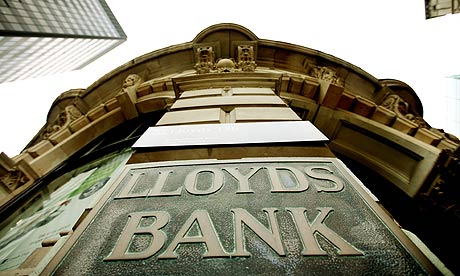
Lloyds Banking Group Plunging into 'The Red' after the backlog of bad debts peak.


Higher-than-expected bad debts of £13.4bn drove Lloyds Banking Group to a £4bn loss in the first half of the year as the rescue takeover of HBOS continued to dent the black horse bank.

The biggest retail bank in Britain admitted that 80% of the soaring bad debts were caused by HBOS, the Halifax and Bank of Scotland, which the group controversially rescued last year during the height of the banking crisis.

But shares in the bank rose 6% to 89p after the bank reassured the market that it believed its so-called impairment charge had now peaked and that it expected the economy to stabilise with a "weak upturn in 2010". The shares are still trading below the 122p at which the taxpayer breaks even on its stake in the bank.

The chief executive, Eric Daniels, said: "Our first-half loss was driven by the high levels of impairment. The core business delivered a resilient performance, despite the weak economy. We are successfully managing the short-term issues and are well positioned to outperform over the medium term, providing value to our customers and shareholders.

"Overall impairments in the second half of 2009 are expected to be significantly lower than the first half with progressive reductions thereafter."
Source: The Telegraph

Bookmark and Share

Tuesday, 4 August 2009

FSA Launches Equity Markets Review

LONDON (Reuters) - The Financial Services Authority (FSA) has launched a wide-ranging review of UK equity markets, covering aspects such as high-frequency trading and so-called "dark pools," the Financial Times reported.

The study is being conducted by FSA staff and Henry Knapman, a veteran of trading and equity market structures at UBS who is on a one-year secondment to the FSA, the paper said in its Tuesday edition.

The move, which will take into account views on anonymous trading venues called "dark pools," comes amid growing questions about how the rise of electronic trading may be affecting investors, the paper added.

An FSA spokesman confirmed the watchdog was talking to market participants "to get their views about changes in the market post-Mifid," but said the review would not lead to a report.

Source: NY Times

Bookmark and Share

Growth In Key Money Supply Gauge Slows

LONDON (Reuters) - Annual growth in a key component of money supply slowed to its weakest since 1999 in the second quarter, Bank of England data showed on Tuesday, just two days before the central bank decides whether to expand its quantitative easing programme.

M4 broad money supply growth, excluding holdings of intermediate other financial corporations, slowed to an annual rate of 3.1 percent in the second quarter of 2009 from a downwardly revised 3.8 percent in the first quarter.

The Bank has identified this subcomponent of M4 growth as a key gauge of whether its quantitative easing policy is boosting the money supply, because it strips out the volatile and sometimes inflated money holdings of firms such as clearing houses included in the overall M4 measure.

"It still shows that money growth is weak up to and including the second quarter," said Philip Shaw, economist at Investec.
Source: NY Times

Bookmark and Share

Friday, 31 July 2009

Regular Saving accounts offer higher rates than standard accounts, because you can only invest small amounts per mont and for a short period of time.

Halifax – Regular Saver
Halifax is currently offering a rate of 5pc on its Regular Saver, which is fixed for one year. To qualify, savers must open a nominated account with Halifax at the same time. Savers can invest between £25 and £500 per month into the account, which can be operated online, in branch or by telephone. If access is required to funds or a payment is missed, then the account is closed and the web saver rate is payable.

Lloyds TSB – Monthly Saver
New and existing Lloyds TSB current account customers are being offered a fixed rate of 5pc on their Monthly Saver account. The account has a 12-month term and savers can invest between £25 and £250 per month into the account. Savers can get instant access to their money if required, without incurring any penalty.

Barclays Bank – Monthly Savings
Savers who invest between £20 and £250 per month with Barclays Bank are being offered a fixed rate of 4.17pc. The account has a 12-month term and can be operated online, in branch or by telephone. Savers can get instant access to their money during the term, but a 1.18pc loss of interest penalty will be payable for the month in which a withdrawal is made.


Source: Moneyfacts

More savings accounts offer bonuses

According to research by moneyfacts, the number of variable rate savings accounts that offer bonuses is increasing, along with the size of the average bonus.

Some 16.4 per cent of variable rate savings accounts now offer savers a bonus. A year ago only 13.4 per cent offered bonuses and even fewer (10.1 per cent) offered bonuses in 2007.

The sizes of the bonuses offered are also growing, with the largest bonus offered totalling 2.65 per cent, compared to 1.55 per cent last year. The average bonus offered is now 1.1 per cent, up from 0.64 per cent in 2008.

The average Briton has accessible savings of £2,474, according to new figures from the Yorkshire Building Society.

Despite the bonuses, it is important to look at a savings account in terms of overall interest payment offered and terms rather than being wooed by the bonus offers, says Moneyfacts.

Michelle Slade from Moneyfacts says, "Savers need to ensure they fully read and understand the terms and conditions of any savings account, before they commit their money."


Source:QCK

Monday, 27 July 2009

Money.co.uk


Everything fom stock trading online, to loans, credit cards and much more!

Money
Bookmark and Share